How to control image downloads and attach GDPR consent to every image

Charities, NGOs and not-for-profits rely on photographs, videos and real stories to show their impact. These hugely valuable assets help people understand a cause, connect with beneficiaries and see where their support goes.
But content featuring real people, especially vulnerable individuals, also brings responsibility. Charities need to know what each person agreed to, which assets their consent covers and what to do if/when that consent expires or is withdrawn.
What is consent management for charities? Consent management for charities is the process of collecting, storing, linking, reviewing and acting on consent for content featuring beneficiaries, supporters, volunteers, staff and other individuals.
Asset Bank’s consent manager brings that process into your digital asset management solution (DAM).
It connects consent forms directly to the photos, videos and audio files they cover, prevents assets from being used before consent is in place, and helps your team respond when consent changes.
The result is simpler administration, stronger governance and greater confidence when using authentic content.
Why consent management matters for charities and not-for-profits
Authentic imagery is powerful because it shows real people and real experiences. For charities and NGOs, however, the people featured may include children, adults at risk, people receiving support or individuals living in sensitive circumstances.
That makes consent more than a box-ticking exercise. It is part of treating people with dignity, protecting their choices and maintaining the trust on which your organisation depends.
The Charity Commission describes safeguarding as a governance priority and says charities should take reasonable steps to protect the people who come into contact with their work. The National Council for Voluntary Organisations (NCVO), the umbrella body for the voluntary and community sector in England, also advises communications teams to consider consent, identification risks and the future use of photos and videos when working with beneficiaries, young people and vulnerable people.
Consent management also supports data protection accountability. Where your organisation relies on consent under UK GDPR, the Information Commissioner's Office (ICO) says you should keep evidence of consent, keep it under review and make withdrawal easy.
Software cannot decide your lawful basis or guarantee compliance. It can, however, make your agreed consent processes clearer, more consistent and easier to demonstrate.
Where charity consent processes often break down
Most consent problems are not down to a lack of care, but simply because information is fragmented and people are busy.
Common problems include:
- Consent forms stored in filing cabinets, email inboxes or shared drives
- Photos and videos held separately from the consent forms that cover them
- Spreadsheets that record consent status but do not contain the underlying evidence
- Uncertainty about which person appears in which asset
- Expiry dates that depend on somebody remembering to check them
- Knowledge held by one employee or volunteer rather than recorded in a system
- Content downloaded by agencies, partners or regional teams before consent changes
- No straightforward process for responding to consent withdrawal
These gaps create two types of cost.
The first is risk. Content may be used after consent has expired or changed, potentially harming the person featured and damaging trust in the organisation.
The second is lost value. A strong image may sit unused because nobody can confidently establish whether the right consent is in place.
A dedicated consent management system helps charities avoid both outcomes.
How Asset Bank’s consent manager helps charities and NGOs
Asset Bank’s consent manager makes consent part of the asset's life inside your DAM. Here is how its core features support charity and not-for-profit teams.
1. Link consent forms directly to the content they cover
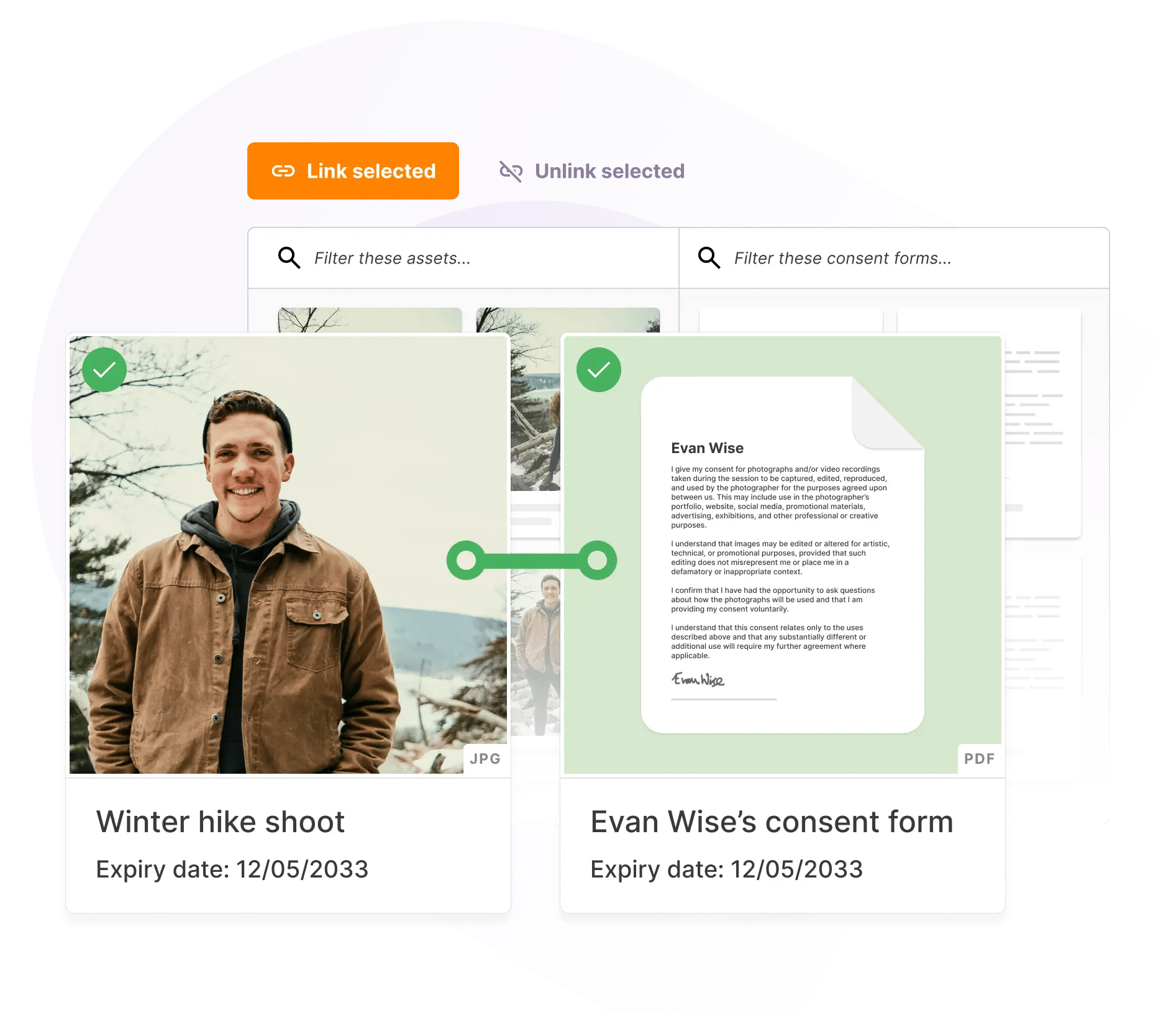 The consent linker connects the right consent forms to the right photos and videos.
This is particularly useful for charity events, community projects and field visits, where one person may appear in many assets and one asset may feature several people. Teams can link one consent form to multiple assets, several forms to one asset, or multiple forms and assets at once.
Keeping the evidence with the content means users don’t need to search through separate folders or ask around before choosing an image. They can see that consent is connected and check any relevant restrictions before use.
You can link consent forms to images at the point of upload – useful for remembering who’s who – or you can upload the photos and link the consent forms later.
2. Hide assets until consent is in place
Consent control acts as a built-in safeguard.
If an uploaded photo or video requires consent but doesn’t yet have the right form linked, it remains visible to administrators only. It cannot be downloaded or used by the wider team until the consent has been connected.
This is valuable for organisations receiving content from volunteers, photographers, local offices, partner organisations or teams working in the field. Assets can enter the DAM immediately without becoming available prematurely.
Once the right consent is linked, the assets are automatically made visible for approved use.
3. See consent status across your DAM
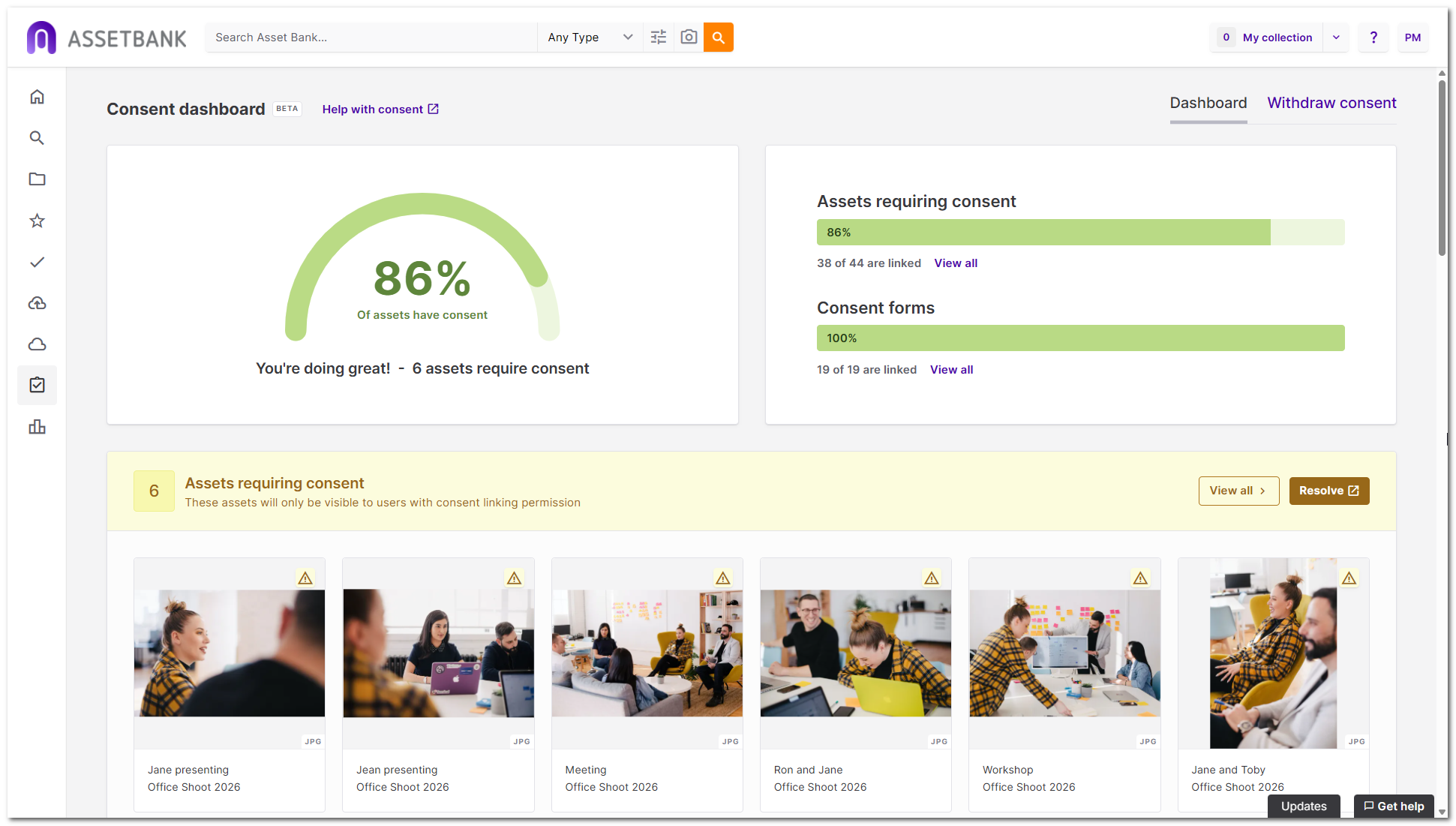 The consent dashboard gives administrators a clear overview of consent across their content library.
It shows:
- The consent status of photos and videos at a glance
- Assets that require consent but do not yet have it linked
- Who uploaded those assets, so administrators know who to contact
- Consent approaching expiry
- Recently expired consent
- Withdrawn consent, including when and why it was withdrawn
The dashboard works as a safety net rather than another system that needs constant monitoring. It helps administrators see what needs attention and move directly to the affected assets.
For charities with small teams, part-time staff or volunteers, that visibility reduces dependence on individual memory. If somebody leaves or is unavailable, another administrator can understand the situation and take over.
4. Stay ahead of consent expiry
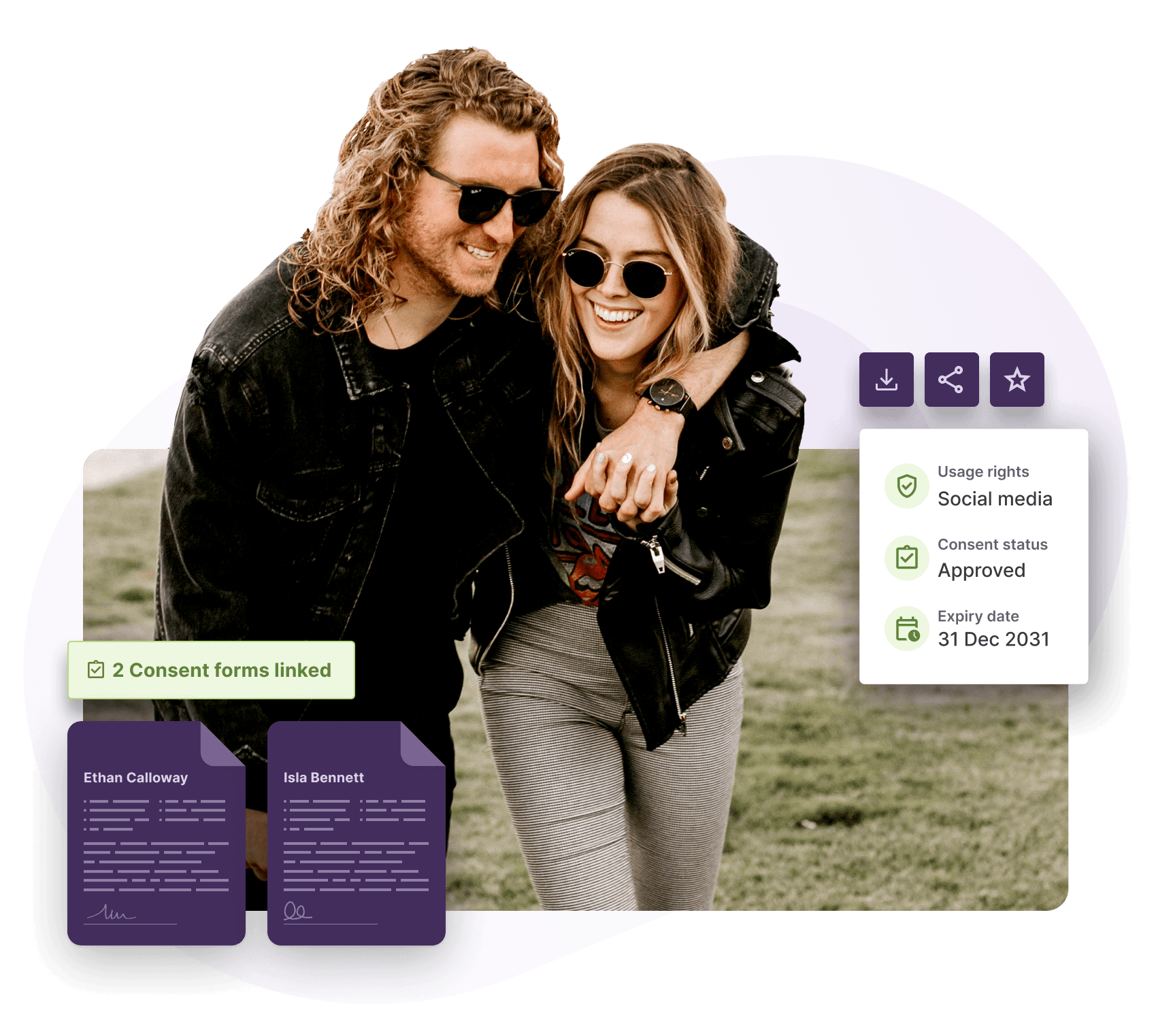 Consent does not necessarily last forever. The appropriate review or expiry period depends on what was agreed, how the content is being used and your organisation's policies.
Consent manager highlights consent approaching expiry, giving administrators time to review the affected assets and seek an extension where appropriate.
When consent expires, Asset Bank automatically hides the connected assets from non-administrators. It also alerts people who previously downloaded them, helping teams identify content that may still be in use outside the DAM.
This is especially useful for recurring fundraising campaigns, long-running website content and printed materials that may remain in circulation for months or years.
5. Respond quickly when consent is withdrawn
 People's choices and circumstances can change. A beneficiary, supporter, employee or volunteer may decide that they no longer want their image used.
The ICO says that when consent is the lawful basis, people must be able to withdraw it and organisations should act on withdrawals as soon as they can.
Consent withdrawal gives administrators a guided process for responding:
- Find the relevant consent form.
- Review every connected photo or video.
- Record the reason for withdrawal.
- Confirm the action.
Asset Bank then – immediately – hides the affected content and alerts previous downloaders. Filenames and thumbnails help recipients recognise the assets they need to review.
The reason for withdrawal is also recorded, creating a clear audit trail of what happened and when.
6. Give teams confidence without making them consent experts
Marketing and communications teams need practical guidance at the point of use. They should not have to interpret a spreadsheet, search through paperwork or become data protection specialists every time they select an image.
By keeping consent status, evidence and restrictions close to the asset, consent manager helps users understand what they can use and how they can use it.
That means fewer internal checks, less uncertainty and faster access to suitable content – while administrators retain control.
The benefits of consent management for different charity teams
|
Team |
How consent manager helps |
|
Marketing and communications |
Find usable photos and videos faster, with consent information connected to the content. |
|
DAM administrators |
See missing, expiring and withdrawn consent in one dashboard and take action quickly. |
|
Safeguarding and data protection teams |
Support consistent processes, clearer records and a stronger audit trail. |
|
Fundraising teams |
Use authentic campaign content with greater confidence and avoid relying on outdated local copies. |
|
Volunteers and regional teams |
Upload content without making it available before the required consent is connected. |
|
Agencies and partners |
Access approved content while the charity maintains control over what remains available. |
A practical charity consent management example
Imagine an international NGO runs a community programme and receives 150 photos from a field team.
Some images show individual participants. Others feature groups. Several consent forms cover one family, while other participants have separate forms. The content team wants to use selected images in a fundraising campaign, but it needs to know which assets are ready.
With Asset Bank consent manager:
- The photos are uploaded and marked as requiring consent.
- The wider organisation cannot access them while consent is still missing.
- An administrator uses the consent linker to connect the relevant forms to the photos.
- The consent dashboard highlights any images that still need attention and shows who uploaded them.
- Once consent is connected, approved images become available for the campaign.
- If consent later expires or is withdrawn, the related assets are hidden and previous downloaders are alerted.
Instead of relying on filenames, spreadsheets and individual memory, the NGO has a clear process that follows the content throughout its life in the DAM.
 Consent management best practices for charities and NGOs
Technology works best when it supports a well-defined organisational process. Use this checklist to strengthen consent management across your charity or not-for-profit:
- Clarify your lawful basis and policies. Work with your data protection, legal and safeguarding specialists to decide when consent is appropriate and what evidence your organisation needs.
- Use clear, specific consent forms. Explain what content will be captured, how it may be used, how long it may be used and how someone can change their decision.
- Keep consent evidence with the assets. Link forms directly to the photos, videos and audio files they cover.
- Record restrictions clearly. Make any limits on channels, regions, campaigns or time periods visible to users.
- Control assets at upload. Keep content requiring consent unavailable until the correct records are connected.
- Review consent regularly. Monitor upcoming expiry dates and refresh consent when your purpose or use changes.
- Create a withdrawal process. Define who handles requests, how affected assets are identified and how users of downloaded content are notified.
- Avoid relying on individual knowledge. Record consent status and decisions in a shared system that remains useful when people change roles or leave.
- Train employees and volunteers. Make sure everyone capturing or uploading content understands the organisation's consent and safeguarding procedures.
- Audit the process. Review missing consent, upcoming expiry and withdrawals regularly, and document any actions taken.
 Frequently asked questions about consent form management for charities
What is consent form management for charities?
Consent management for charities is the process of collecting, storing, linking, reviewing and acting on consent for content featuring real people. It helps an organisation establish what someone agreed to, which assets that consent covers, when it should be reviewed and what to do if consent is withdrawn.
Why should charities link consent forms directly to photos and videos?
Linking consent directly to content makes the evidence easier to find and check. It reduces reliance on spreadsheets, shared folders and individual memory, while helping users understand whether an asset is ready for use.
What happens when consent expires in Asset Bank?
When linked consent expires, Asset Bank automatically hides the affected assets from non-administrators and alerts previous downloaders. Administrators can also see consent approaching expiry, giving them time to review it or seek an extension where appropriate.
What happens when someone withdraws consent for their image to be used?
Asset Bank’s consent manager identifies every asset connected to the relevant consent form, hides the affected content and alerts previous downloaders. It also records the withdrawal reason and date to support a clear audit trail.
Can consent management software guarantee GDPR compliance?
No. Software cannot choose the correct lawful basis, define your policies or guarantee compliance. Consent management software can support compliance by keeping evidence connected to content, applying safeguards consistently and helping your organisation record and act on consent changes.
Can consent manager handle group photos and complex photoshoots?
Yes. Asset Bank’s consent linker supports one-to-many, many-to-one and many-to-many connections. This means one form can cover several assets, several forms can be connected to one group photo, and multiple forms and assets can be linked together.
Protect people, preserve trust and keep campaigns moving
For charities, NGOs and not-for-profits, good consent management is about more than reducing compliance risk. It is about respecting the people behind the content and protecting the trust that makes your work possible.
Asset Bank consent manager makes that responsibility easier to manage. It keeps consent connected to your assets, prevents content from being used before consent is in place and helps your team act when consent expires or is withdrawn.
Simple for marketers. Strong on compliance. Built for confident, responsible storytelling.
Discover Asset Bank consent manager or book a demo to see how it works.
Editorial note:
This article provides general information and does not constitute legal advice. Organisations should seek appropriate advice for their specific circumstances.
Dont’ forget to share this post