How to connect Canva with your brand asset library
Choosing between Asset Bank and Bynder? Both are powerful digital asset management (DAM) platforms designed to help organisations organise, find, manage and share their digital content.
Both offer sophisticated features, including AI-powered search, custom metadata, version control, video management, approval workflows and integrations with creative applications.
So, what's the difference?
While Bynder offers an extensive content operations suite, Asset Bank focuses on delivering powerful, flexible DAM functionality in an intuitive, configurable platform. For marketing teams that need advanced features without unnecessary complexity, Asset Bank is a compelling Bynder alternative.
Let's explore how the two platforms compare, where they differ and what to consider when choosing the right DAM for your organisation.
Asset Bank vs Bynder: At a glance
Asset Bank and Bynder cover many of the same essential digital asset management requirements.
| Capability | Asset Bank | Bynder |
|---|---|---|
| Centralised asset library | Yes | Yes |
| Custom metadata and taxonomy | Yes | Yes |
| Traditional folders and subfolders | Yes | No – taxonomy-based |
| AI-powered search and tagging | Yes | Yes |
| Visual similarity search | Yes | Yes |
| Video management and clipping | Yes | Yes |
| Version control | Yes | Yes |
| Creative application integrations | Yes | Yes |
| Permissions and approval controls | Yes | Yes |
| Usage rights management | Yes | Yes |
| Dedicated Consent Manager | Yes | Different approach |
| Native creative production suite | External integrations | Yes |
| Published package pricing | Yes | Custom quotation |
Feature availability may depend on the package, modules or integrations selected.
The important question isn't simply which platform has more features. It's which one delivers the functionality your team actually needs, in a way that people will find easy to use.
1. Organising assets: Folders vs metadata-based taxonomy
One of the clearest differences between Asset Bank and Bynder is how they organise digital assets.
Asset Bank: Folders, metadata and AI search
Asset Bank gives organisations several ways to organise and discover content.
Its traditional folder and subfolder structure will feel familiar to anyone who has used a shared drive. Administrators can organise assets by department, location, brand, campaign or another structure that makes sense for their organisation.
For example, an international marketing team could create folders for different countries, then subfolders for campaigns, photography, video and brand materials.
Permissions can be configured at folder level, ensuring each user group sees and accesses the content relevant to them.
But Asset Bank doesn't rely on folders alone. It also provides configurable metadata, advanced filtering and AI-powered search, giving teams multiple ways to locate the right files.
Bynder: A taxonomy-first approach
Bynder takes a different approach. Its core DAM doesn't use traditional folders. Instead, it organises content using a metadata-based taxonomy built around configurable categories and properties.
This gives users the flexibility to search and filter content across multiple classifications, without restricting an asset to a particular folder location.
For organisations with a well-established metadata strategy, this approach can work extremely well.
However, teams that prefer familiar folder navigation, or need to organise access around regions and departments, may find Asset Bank's combination of folders, metadata and AI search more suitable.
For a detailed explanation, see Bynder's own guide to its taxonomy.
2. AI-powered DAM: How do Asset Bank and Bynder compare?
AI has become an important part of modern digital asset management, helping teams reduce manual tagging and find content faster.
Bynder has invested heavily in AI, including intelligent asset discovery, metadata automation and configurable AI agents.
But teams don't need Bynder to benefit from sophisticated AI-powered DAM.
Asset Bank's AI capabilities
Asset Bank offers a range of intelligent features designed to improve asset discovery and reduce administration:
- Natural language search: Find assets using everyday descriptions rather than relying on exact filenames or tags.
- Automatic metadata: Generate relevant tags, image descriptions and alt text.
- Similar image suggestions: Discover assets with a similar subject, style or appearance.
- Reverse image search: Use an image to locate matching or visually related files.
- Duplicate detection: Identify duplicate uploads to help maintain an organised library.
- Audio and video transcription: Make spoken content easier to search and manage.
These features make Asset Bank a strong choice for organisations looking to introduce AI into their asset management workflows.
See all Asset Bank's AI features.
Where Bynder differs
Bynder also offers advanced AI search and automated metadata enrichment. Its wider AI capabilities extend into configurable agents designed to support tasks such as content enrichment, asset transformation and brand compliance.
That additional functionality may appeal to organisations with complex content automation requirements.
For marketing teams primarily looking to find assets faster, automate tagging and improve content reuse, Asset Bank already offers an extensive range of AI-powered capabilities.
Explore Asset Bank's AI features.
3. Video management: Both DAMs offer advanced capabilities
Video is increasingly important to marketing, but managing large video libraries can be difficult without the right tools.
Both Asset Bank and Bynder offer more than simple video storage.
With Asset Bank, teams can preview video files, scrub through footage and select specific clips to download without having to retrieve the entire original file.
Users can also resize videos for different requirements, helping them reuse existing footage for social media, presentations and other marketing channels.
Asset Bank supports subtitles, including multiple languages, with tools for managing subtitle tracks alongside the relevant video assets. AI-powered transcription also helps improve video searchability.
Bynder offers comparable core video management features, including previewing and clipping footage. Its Studio solution additionally supports video-based creative production.
The distinction comes down to what your team needs.
If you want to store, find, control and repurpose video assets, Asset Bank offers powerful tools within its DAM. If you also need a broader content creation environment, Bynder's additional solutions may be worth exploring.
Explore Asset Bank's video management capabilities.
4. Integrations: Connecting your DAM to creative workflows
A good DAM should work with the software your marketing and creative teams already use.
Both platforms support integrations that help users access approved assets without repeatedly downloading and uploading files.
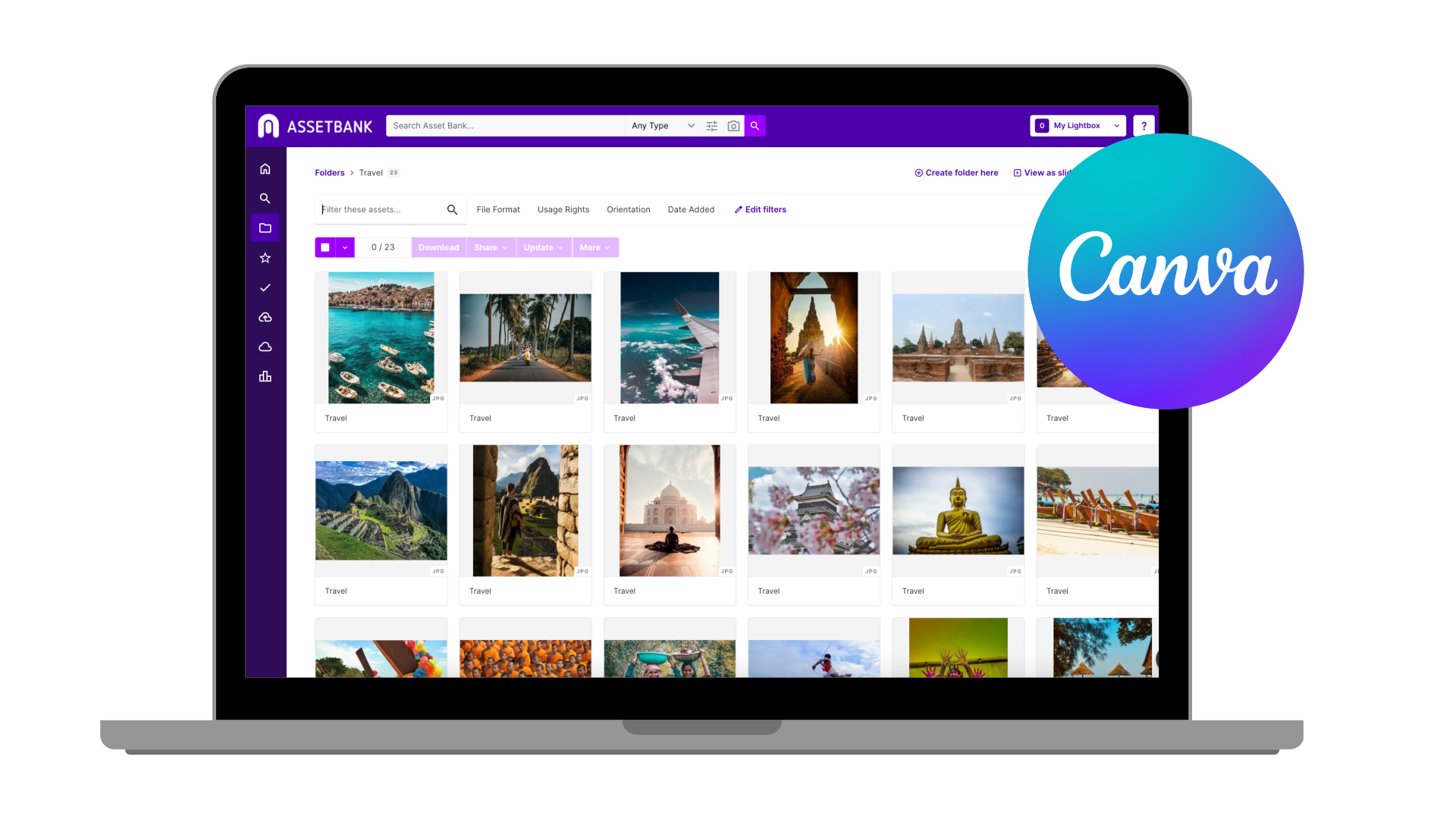
Asset Bank integrates with popular creative and productivity applications, including:
Many of these connections are available through the optional CI HUB connector. Asset Bank also provides a REST API for organisations that need custom integrations.
Bynder has an extensive integration ecosystem, connecting its DAM with creative, content management and marketing platforms.
For most organisations, the important question isn't how many integrations a vendor lists. It's whether the platform connects reliably with the applications your team actually uses.
When comparing Asset Bank and Bynder, identify your essential integrations and confirm which are included in the proposed package.
Explore Asset Bank's integrations
5. Configurability, permissions and version control
Every organisation works differently. A DAM needs to accommodate different teams, workflows and access requirements.
Asset Bank is highly configurable, allowing organisations to tailor metadata fields, folder structures, user permissions and approval workflows.
Administrators can control which assets users can view, upload, edit and download.
Asset Bank also includes version control, allowing teams to maintain a clear history of asset updates. Automatic notifications can alert users when assets they previously downloaded have been updated, helping prevent outdated content from remaining in circulation.
Expiry dates and usage restrictions provide further controls over how content is managed and distributed.
Bynder also provides configurable permissions, approval functionality and version management. Its dedicated Asset Workflow solution extends collaboration into more advanced creative proofing and review processes.
For organisations that need detailed creative production and approval workflows, this may be a useful addition.
For teams whose priority is managing approved assets, controlling access and maintaining consistent content across departments, Asset Bank provides a flexible and comprehensive solution.
6. Usage rights and consent management
Digital asset management isn't just about finding content. Marketing teams also need confidence that their assets can be used appropriately.
Both Asset Bank and Bynder support digital rights management, including controls relating to asset access and usage.
However, Asset Bank offers particularly extensive capabilities for managing usage rights, permissions and consent.
Restrictions can be recorded directly against assets, helping users understand where, when and how content may be used. This is especially valuable when working with licensed imagery, time-limited campaigns or content involving identifiable people.
Asset Bank's dedicated consent manager
Asset Bank's consent manager connects consent forms and model releases directly to the images, videos and audio files they cover.
This means organisations can:
- Link consent records to the relevant assets.
- Identify content with missing or expiring consent.
- Automatically restrict affected assets when consent expires or is withdrawn.
- Alert previous downloaders when consent expires.
- Monitor consent records through a central dashboard.
For organisations handling large volumes of photography and video involving people, these controls can significantly reduce manual administration and the risk of inappropriate content use.
Bynder supports rights information, permissions and the attachment of supporting files such as release forms. Buyers should check whether its available consent workflows meet their particular requirements.
7. Pricing: What does Asset Bank cost compared with Bynder?
Pricing is another important consideration when comparing DAM platforms.
Asset Bank pricing
Asset Bank publishes its starting package prices, making it easier to understand the likely investment before booking a demonstration.
| Package | Starting annual price |
|---|---|
| Essential | £5,949 |
| Professional | £9,849 |
| Enterprise | £19,499 |
Prices exclude one-off set-up fees.
Additional services, integrations and modules may incur extra costs.
Asset Bank's packages allow organisations to select a level of functionality that suits their requirements, rather than investing in a wider platform simply to access core DAM features.
Bynder pricing
Bynder uses a quotation-based approach, with pricing tailored to an organisation's requirements.
Its wider range of solutions includes additional capabilities such as Studio, Content Workflow and Asset Workflow. These may be useful for businesses that want to manage more of their content operations through one supplier.
However, it's important to establish which modules are included and what any additional functionality will cost.
Compare the total cost, not just the subscription
When evaluating either platform, consider implementation, integrations, storage, user numbers, training and the functionality included in each package.
A platform with more features isn't necessarily better value if your organisation won't use them.
For teams that want sophisticated DAM functionality without investing in an extensive content operations suite, Asset Bank may offer a more cost-effective fit.
8. Ease of use and customer support
Even the most advanced DAM will struggle to deliver value if people find it difficult to use.
Asset Bank is designed to be intuitive for everyday users, while giving administrators the flexibility to configure the platform around their organisation's needs.
Familiar folder navigation can make onboarding easier for teams moving away from shared drives or other asset management systems. Configurable metadata and search provide more advanced options when they're needed.
Asset Bank also offers tailored onboarding and ongoing support from its UK-based customer success team.
Bynder is an established enterprise platform with extensive functionality, and its approach may suit organisations with specialist DAM administrators and more elaborate content operations requirements.
The best way to assess usability is to test both systems with the people who will use them every day – not just those responsible for purchasing the software.
9. Why Telenor Group moved to Asset Bank
Sometimes, a powerful DAM can offer more functionality than an organisation actually needs.
That was the experience of global telecommunications company Telenor Group.
After eight years using a large, complex DAM, Telenor wanted a simpler, more cost-effective solution. Its previous system included features that went unused, while some of the functionality the company needed was available only at an additional cost.
Asset Bank offered the combination of powerful DAM functionality and straightforward navigation that Telenor was looking for.
Its folders and subfolders, flexible permissions and familiar interface made it easier to organise and migrate assets across international teams.
Today, Asset Bank manages more than 30,000 digital assets for Telenor, with access available to approximately 11,000 employees.
“We really like the folder approach.”
– Henrik Sigmundstad, Director of Multimedia, Telenor Group
10. Which is better for your organisation: Asset Bank or Bynder?
There isn't a single DAM that's right for every business.
Bynder may be a strong choice if your organisation wants an extensive content operations platform, with dedicated solutions for creative production, advanced proofing, content workflows and omnichannel delivery.
Asset Bank is a strong choice if you're looking for a powerful, flexible DAM that combines advanced AI, video management, integrations and permissions with intuitive navigation, traditional folders and transparent pricing.
It's particularly well suited to marketing teams that want sophisticated asset management functionality without adding unnecessary complexity to their day-to-day work.
Asset Bank also offers extensive usage rights and consent management capabilities for organisations that need additional control over their content.
Ultimately, the right choice depends on the workflows you want to improve, the features your team will actually use and the value you'll receive from your investment.
Asset Bank vs Bynder: Frequently asked questions
Is Asset Bank a good alternative to Bynder?
Yes. Asset Bank offers many of the advanced DAM capabilities available in Bynder, including AI-powered search, automated tagging, version control, video management, permissions and creative integrations. It also provides traditional folders and subfolders, flexible configuration and published package pricing.
Does Asset Bank have AI features like Bynder?
Yes. Asset Bank offers natural language search, automatic metadata generation, similar image suggestions, reverse image search and duplicate detection. Bynder additionally offers configurable AI agents for more extensive content automation.
Does Bynder support folders and subfolders?
Bynder's core DAM uses a metadata-based taxonomy rather than traditional folders. Asset Bank supports both folders and subfolders alongside custom metadata and AI-powered search.
Is Asset Bank cheaper than Bynder?
Asset Bank publishes annual package prices starting at £5,949, plus set-up fees. Bynder provides tailored quotations, so a reliable price comparison requires proposals based on equivalent requirements.
Can Asset Bank support large international organisations?
Yes. Asset Bank is used by global organisations including Telenor Group, which manages more than 30,000 assets and provides access to around 11,000 employees across multiple markets.
Ready to compare Asset Bank and Bynder?
Bynder isn't the only option for organisations looking for advanced digital asset management.
Asset Bank offers powerful AI, intuitive asset organisation, video management, flexible permissions and creative integrations, all within a DAM designed to make managing content straightforward.
If you're exploring DAM software, we'd love to show you how Asset Bank compares.
Dont’ forget to share this post


Tags:

Di Taylor
Mar 27, 2025
Di, Asset Bank's customer acquisition lead, is a seasoned marketing professional and digital asset management (DAM) expert at Asset Bank.
Passionate about solving real-world challenges, Di knows firsthand how effective DAM solutions can transform team morale and productivity. After experiencing one too many file management frustrations, Di dedicated her career to promoting software that addresses these common pain points.
Today, she helps businesses streamline their file storage efficiency, security, and accessibility while sharing practical insights about Asset Bank’s DAM SaaS. (So many potential puns!)
Di’s journey to Asset Bank:
Di’s career began in the travel industry, where she held a variety of marketing, analytics, and e-commerce roles focused on helping people book the trips of a lifetime. She later transitioned to a B2C SaaS genealogy company, enabling individuals to uncover their family histories.
Since joining Asset Bank in 2023, Di has delved into the latest martech trends, shared actionable productivity tips, and connected with readers to tackle digital asset management challenges head-on. Alongside her team, she works with enterprise and SMB clients, empowering them to enhance efficiency through innovative DAM strategies.
Di’s ‘best bits’ of Asset Bank:
"I love working for a tech company that empowers marketers to be more productive. It’s a mission close to my heart, and I feel incredibly fortunate to combine my passion with my day job."
Why Di loves to work here:
"It’s the people! Collaborating daily with a talented, passionate team who truly care about our brand and customers inspires me to achieve great things."
Let’s connect!
Want to simplify your workday with DAM solutions? Reach out to Di and discover how Asset Bank can help your business work smarter.