When brands need a DAM with consent management and compliance

Franchise growth can create a brand governance problem
Growth is the goal of every franchise network.
Whether you're managing 20 locations or 2,000, franchising offers a powerful way to scale a brand while leveraging local expertise and entrepreneurial drive.
But growth creates a challenge that many franchise organisations underestimate:
How do you maintain brand consistency, protect marketing assets, manage compliance, and give franchisees the freedom they need to market locally?
For many franchise businesses, the answer is still a patchwork of shared drives, email attachments, Dropbox folders, SharePoint sites, local hard drives, and manual approval processes.
The result is predictable:
- Franchisees use outdated assets
- Marketing teams waste time distributing files
- Brand consistency suffers
- Compliance risks increase
- Campaigns take longer to launch
- Nobody knows which assets are being used where
As franchise networks expand, content governance becomes just as important as content creation.
This is where digital asset management (DAM) becomes a strategic necessity rather than a marketing convenience.
The franchise marketing challenge nobody talks about
Most franchise systems face a fundamental tension.
Corporate teams need control.
Local franchisees need flexibility.
Head office wants every location to represent the brand consistently, while franchisees need to adapt campaigns to local markets, audiences, and promotions.
Without the right technology, these objectives often conflict.
Corporate teams respond by introducing more approval processes.
Franchisees respond by creating their own workarounds.
Before long, multiple versions of logos, promotional materials, videos, social graphics, and sales collateral are circulating across the network.
The bigger the franchise becomes, the harder this problem gets.
Industry experts consistently identify inconsistent branding, asset duplication, approval bottlenecks and compliance challenges as some of the biggest operational obstacles facing multi-location franchise organisations.
The five biggest pain points facing modern franchise networks
1. Brand inconsistency across locations
Customers expect a consistent experience regardless of location.
Yet franchisees often create local marketing materials using outdated logos, incorrect imagery, old messaging, or unauthorised creative assets.
Over time, these inconsistencies weaken brand equity and customer trust.
A franchise's greatest asset is often its brand.
Protecting it requires far more than a PDF brand guidelines document.
2. Marketing assets scattered across multiple systems
Many franchise organisations still rely on:
- Shared drives
- Email attachments
- File transfer services
- Local servers
- Personal cloud storage
This creates confusion around:
- Which version is current
- Which assets are approved
- Who can access what
- Where files are stored
Employees spend valuable time searching for assets instead of using them.
Research consistently shows that one of the primary purposes of DAM systems is making assets easily searchable, discoverable and accessible through structured metadata and centralised storage.
3. Compliance and usage rights risks
This is where many DAM conversations become too simplistic.
Most vendors focus on storage and search.
The bigger risk is compliance.
Franchise organisations frequently use:
- Licensed photography
- Stock imagery
- Agency-created content
- Influencer content
- User-generated content
- Employee photography
- Customer imagery
Every asset may have usage restrictions attached.
These can include:
- Geographic limitations
- Expiry dates
- Channel restrictions
- Licensing terms
- Attribution requirements
If those rights are not visible and enforceable, misuse becomes inevitable.
One franchise location accidentally using expired imagery can expose the entire brand to reputational damage and legal risk.
4. Consent management becomes unmanageable
Franchise organisations often capture images of:
- Customers
- Staff
- Students
- Members
- Event attendees
- Community participants
The challenge is rarely obtaining consent.
The challenge is managing it.
Many organisations still track consent through spreadsheets, PDFs, folders, and disconnected systems.
When consent expires or is withdrawn, locating every related image can become almost impossible.
This creates significant operational and compliance risk.
5. Access control complexity
A growing franchise network typically involves:
- Franchisees
- Regional managers
- Corporate marketing teams
- Agencies
- Suppliers
- Partners
- International markets
Not everyone should have access to everything.
Without robust permissions, organisations either:
- Restrict access too heavily and create bottlenecks, or
- Grant excessive access and lose control
Neither approach scales effectively.
Why traditional DAM is no longer enough
Historically, DAM systems were designed primarily as content libraries.
Their job was to store files and make them searchable.
Today's franchise organisations need far more.
They need systems that actively govern how assets are used.
A modern DAM should help organisations:
- Control access
- Protect rights
- Manage consent
- Maintain audit trails
- Enforce governance policies
- Reduce compliance risk
The distinction is important.
Managing assets is useful.
Managing risk is essential.
The rise of compliance-led DAM
As regulations become more complex and content volumes continue to grow, a new category of DAM capability is becoming increasingly important: DAM software with compliance management at its core.
For franchise organisations, this means being able to answer questions such as:
- Is this image licensed for use in this territory?
- Does consent remain valid?
- Who downloaded this asset?
- When does usage expire?
- Which franchisees have access?
- Has this asset been superseded?
These questions can no longer be answered manually at scale.
The organisations that manage them effectively gain a significant operational advantage.
What franchise brands should look for in a DAM platform
Centralised asset management
Every approved asset should live in a single source of truth.
This eliminates duplication and ensures franchisees always access current content.
Granular permissions
Different users need different levels of access.
The platform should support sophisticated user groups, territories, brands, and business structures.
Usage rights management
Usage restrictions should be visible and enforceable.
Teams should immediately understand how assets can and cannot be used.
Consent management
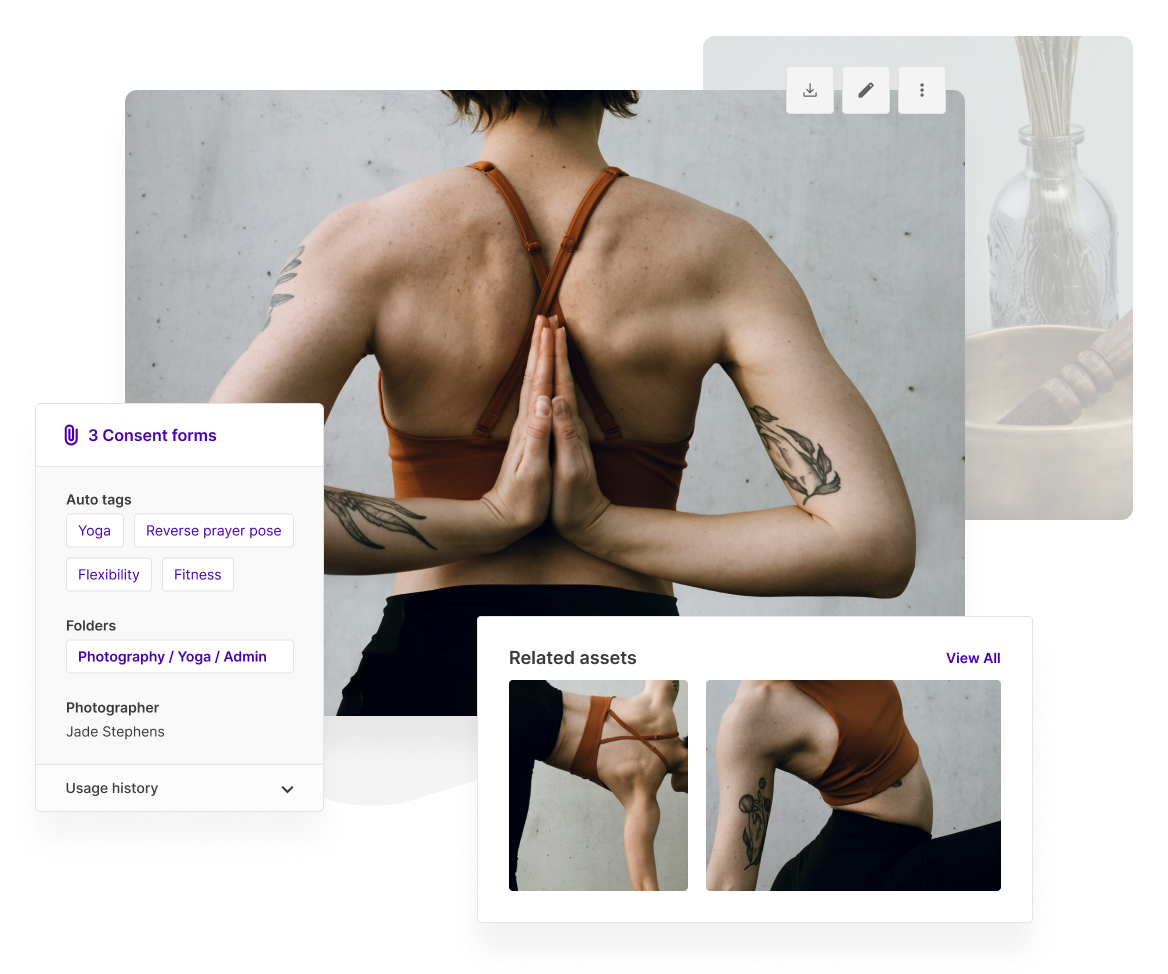
Consent records, such as model release forms, should be linked directly to the assets they govern.
Expiry tracking, notifications, and audit trails should be automated.
Version control
Users should always access the latest approved asset version while maintaining historical records.
Powerful search and discovery
Assets should be discoverable through metadata, taxonomy, AI-powered tagging, and natural language search.
Why compliance is becoming the next competitive advantage for franchise brands
Most franchise organisations already understand the value of consistency.
The next challenge is governance.
As content ecosystems become larger and more distributed, organisations that can confidently answer:
"Can we use this asset?"
And will move faster than organisations that constantly ask:
"Should we use this asset?"
Confidence comes from control.
Control comes from governance.
And governance increasingly depends on having the right DAM platform in place.
The future of franchise marketing is not simply creating more content.
It is ensuring every asset is compliant, approved, discoverable, and accessible to the right people at the right time.
That is how modern franchise brands scale without losing control.
Frequently asked questions
What is DAM software for franchises?
A digital asset management (DAM) system is a centralised platform that stores, organises, manages and distributes brand assets such as images, videos, documents, templates and marketing collateral across franchise networks. It ensures franchisees always have access to approved content.
Why do franchise businesses need DAM software?
Franchise businesses need DAM software to maintain brand consistency, streamline content distribution, improve collaboration, manage permissions and reduce compliance risks associated with asset usage.
How does DAM help maintain brand consistency?
A DAM platform provides a single source of truth for approved assets, ensuring franchisees use current logos, imagery, templates and messaging rather than outdated or unauthorised content.
What compliance risks do franchise organisations face?
Common risks include expired image licences, unauthorised asset usage, missing copyright attribution, expired consent, improper access permissions and the use of outdated marketing materials.
How does Asset Bank help franchise organisations stay compliant?
Asset Bank enables organisations to manage usage rights, permissions and consent alongside the assets themselves. This helps marketing teams use assets confidently, control access and protect rights while reducing the risk of misuse and compliance breaches.
What makes Asset Bank different from other DAM platforms?
Asset Bank differentiates itself through its focus on compliance. While many DAM platforms focus primarily on storage and search, Asset Bank helps organisations stay on the right side of image licences, get consent right every time and keep content in the right hands through advanced usage rights, consent management and permissions controls.
Can franchisees access only the assets relevant to them?
Yes. Modern DAM platforms such as Asset Bank support granular permissions and user groups, allowing organisations to control exactly who can view, edit, upload or download assets across locations, regions and business units.
Book a demo with the team to find out more.
Dont’ forget to share this post


Tags:

Paul Mulvee
Jun 10, 2026
As product manager here at Asset Bank, Paul’s our in-house product hero. Having been with the team since 2010(!) he knows every inch of our digital asset management software. He’s got a penchant for product success, and is always engineering new features, or updating existing technologies across our DAM platform.
With years of experience helping businesses organise and optimise their digital libraries, Paul’s passionate about enabling teams to work smarter, save time, and unleash their creative potential.
At Asset Bank, Paul works closely with our customers to continually evolve our digital asset management offering, so that it grows with them and increases in value over time.
Paul’s Asset Bank story
Paul joined Bright Interactive (Asset Bank’s parent company) in 2010, after nine years' working in various other roles in the software industry. After travelling for a year, Paul relocated and applied for a job at Bright after hearing great things about the company from a recruiter.
He then joined Bright (now Asset Bank), starting as a support manager and growing this team, followed by a move to consultancy, where he used his in-depth product knowledge to help configure solutions for prospects and existing customers.
From there, he took up a role as a senior sales consultant for eight years, prior to moving into his current position as product manager for Asset Bank.
Paul is a major champion for our digital asset management solution. He knows how much positive impact our software has had for the hundreds of organisations he has worked with, and this drives him to continue to make it more powerful, flexible and easy to use.
Paul works with a team of developers, UX, UI, and testing engineers, working together to solve complex technical problems and produce solutions with the best user experience possible.
Paul’s ‘best bits’ of Asset Bank:
“It’s great working in an industry that is always evolving as there is a constant stream of new challenges and new technologies to get stuck into. This keeps everything fresh and enjoyable.”
Why Paul loves to work here:
“I love speaking with our customers and all the other Asset Bank Teams; gathering requirements, prioritising the roadmap and coming up with innovative solutions. I also like that I’ve returned to my computing science roots, and get to work with the amazing talent in our development team.”
Connect with Paul to learn how Asset Bank can transform your digital asset management strategy!
Connect with Paul today to chat all things DAM
Read more of Paul's industry expertise on the DAM News website:
Whose rights is it anyway? Managing AI-generated content and copyright in DAM
Efficiency isn't free: The ethical cost of AI in DAM
Why the next phase of DAM is about people, not just platforms
AI can describe your images. It can’t understand your business.